Showing posts with label Book Reviews. Show all posts

Saturday, October 2, 2021

A-Z 2021 P - The Manuscript Found in Saragossa (Jan Potocki, 1815)


OK, let's see if you can follow along with me, here.

This is a novel written by a Polish nobleman.  He wrote it in French, working on it over a span of roughly twenty years, and its final form isn't necessarily his final draft, as the author committed suicide while still crafting it.  There is no known extant copy of the complete novel in the original French, so roughly 20% instead only exists as a Polish translation of the missing original.  That 20% was later translated back into French, so that the novel could exist in something at least close to its original form.

With me so far?

The novel itself purports to be a manuscript found in a locked safe and written in Spanish.  The finder, a French soldier, is taken prisoner by the Spanish army and discovers that the commander in charge of the unit that has captured him is a descendant of the writer of the manuscript, and proceeds to translate it into French to share the stories within.  The manuscript's writer, one Alphonse von Worden, is a Walloon (read: French-speaking Belgian) soldier who, through a series of misadventures, finds himself stuck in a small valley in Andalusia, traveling around and meeting those who live there, and hearing stories they tell about themselves and their families.  He records the stories being told in his diary over the 66 days he spends in the Andalusian countryside.  Those stories may include other stories within them, which may contain further stories within them...

Yeah.  This is possibly the most intricately-nested set of stories I've ever read.  There are several times that the narrative ends up five layers deep.

The Manuscript Found in Saragossa is a difficult book to sum up.  I'd suggest that it's unfilmably so, except that a film exists (albeit one that is three hours long).  In fact, I actually have it on DVD, somewhere.  It's tempting to directly compare this work with the Thousand and One Nights and the serialized storytelling of Scheherazade, but there's a significant difference between the two sets of stories, primarily in the way that the whole collection of stories is working toward a single unified tale.  There's a whole tapestry being woven here, where multiple of the characters have linked backstories, and especially toward the end of the work, people who figure in one story appear in others, from a different perspective.

The central thematic concern is the mystery of the Gomelez, a Moorish clan of sorts that possesses untold and seemingly endless wealth, living in the ruins of a castle and a network of hidden caves under the valley that Alphonse's narrative takes place in.  For much of the book, it's unclear just what the full nature of the events that befall Alphonse might be; the existence of the supernatural is treated as a matter of course, with several stories dealing with magic or ghosts.  Characters appear and disappear in different guises, and the longest of the tales, that of the gypsy chief Pandesowna, involves repeated instances of changing his appearance and identity in order to navigate his world.

The book reads surprisingly modern; while part of that may be due to its position as a somewhat recent work in translation (and re-translation, as it were), it equally has a sort of out-of-time quality to it, where even though the characters refer to historical figures that were active and that they might have encountered in their adventures, there is little knowledge of the political climates of 17th and 18th century Europe necessary to understand what's going on.  Rather, the far more interesting aspect to this work is the way that it shifts so cleanly between genres, as the various tales take shape, and the way that every narrator has a noticeably different voice, but with everything being in service of Alphonse's journey, each of the twenty or so individual tales is able to possess a completely different feel without being utterly jarring.

It's a fascinating piece of literature, to be sure.  Perhaps the only truly disappointing thing I can say about it is that the end felt rather rushed, though that may be a function of the author's cutting-short of his own authorship.  Even so, the vast majority of questions were answered, and few loose threads were left over.  If nothing else, that serves to show how carefully-crafted this work is.

Tuesday, September 7, 2021

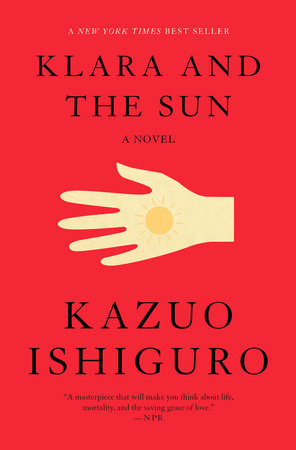
Klara and the Sun (Kazuo Ishiguro, 2021)

So, here's something I didn't expect.  A dystopian novel where the dystopia not only isn't a focus, but also isn't actually spelled out at all.

The titular narrator in Kazuo Ishiguro's Klara and the Sun is an Artificial Friend, a robot specifically manufactured to provide companionship to lonely children.  The world on display is largely our own, though the presence of functional human-like robots should be the first indication that we're firmly in sci-fi territory.  The first 40 pages or so concern Klara's time at the store she is eventually purchased from, where her specific gifts become clear.  Klara is particularly adept at observing details and putting them together, which leads to some combination of insightfulness and surrealism in her interactions with the larger world around her.  She comes to believe, for example, that the Sun (as in the incandescent orb in the sky) is alive, has his own will (and yes, the Sun in Klara's mind is gendered), and is capable of performing acts of miraculous healing.  She also believes that the Cootings Machine, a piece of construction equipment which never has its purpose spelled out but which emits so much Pollution that it can blot out the Sun in its immediate surroundings, is obviously the Sun's great foe (and therefore the villain of Klara's story).

Klara's narration has a strange, somewhat disjointed quality to it; there's an almost child-like diction, with a marked tendency toward referring to others in the third person, even when they're the only person she's speaking to.  Her observations can be somewhat unsettling at times, and she has far from a full understanding of emotions, leading her to say and do things that are perhaps not the best choice at the time.

Most of the book is focused on Klara's interactions with Josie, a sickly adolescent girl who chooses her from the store.  From the start, there's something a little off about the whole situation; Josie's mother directly asks Klara to show her imitation abilities off in the store, after a few encounters across the shop window, and the relationship between the Mother and Klara is anything but normal, as the story progresses; the reason for this becomes clear, but the implications are decidedly chilling.

The world on display is a sort of light dystopia, plausible but thankfully not something currently feasible.  Robots have largely replaced even some highly-trained and creative-thinking workers (referred to as "substitution"), and colleges are actively refusing entry to new students who haven't been "lifted", a process of gene-therapy that yields higher intellect (though in Josie's case, also led to significant health issues).  The stresses that this puts on the system are obvious, and appear generally to be exactly what one might expect increased unemployment on that sort of scale to become.

Klara's place in all of this is initially confusing to her, but as she begins to realize what the purpose of bringing her into the household actually is, she finds herself divided in how best to act.  She believes the clear solution is to requrst assistance from the Sun and his miraculous healing, going so far as to accept a quest from him to kill the Cootings Machine at any cost.

It's a delightful read, and the way that the shape of the dystopia creeps in slowly, only as Klara herself becomes aware of each aspect, is amazing.  The way that Klara sees the world is inherently different than the way humans do (details broken out into boxes, shapes abstracted into primitives when she isn't focusing on them specifically) and this comes out perfectly, though it is a touch jarring at first.

I find myself wondering how similar Ishiguro's other works might be.  I know for sure that he has written other, more overt dystopian literature that deals with rather darker themes, though I have little interest in reading it at this time (so soon after Nineteen Eighty-Four).  Even so, though, he's definitely going on my list of authors I need to read more of.


Sunday, September 5, 2021

A-Z 2021 O - Nineteen Eighty-Four (George Orwell, 1948)

...I don't think I was ready for this.

There's two directions I could take this post.  There's the one where I take an objective view of Nineteen Eighty-Four and look at the book in a vacuum, digging into the narrative and the writing style and not much else.

That direction is boring.

There's also the direction where I take a very much subjective view of the book, look at the politics and messages in the text and the warnings that are present here, and dig into the relevance that the book has to the modern world.

That direction is uncomfortable and could potentially put all of my own political and sociological views on display if I'm not careful.

That direction is also the one I have to go in, because this book was an uncomfortable read and I need to unpack things a bit before I move on to my next read.  There was never any other option, I was always going to go down this path in writing this piece.

So, we really have to start with the general idea of what this book is.  The phrase 'Big Brother is watching you' has entered the popular consciousness, to the point that there's a whole global long-running franchise of reality shows called Big Brother.  This comes from a partial understanding of the nature of Big Brother and the general form of the police state that is Oceania and more specifically London under the control of Ingsoc.  Yes, it's a surveillance state; nothing can be done that isn't potentially being watched.  But there's a lot more to it than just the surveillance.

The central idea that is at work in Ingsoc London is so much worse than merely being a surveillance state, though.  For one, this is where the idea of "thought police" comes from.  Any ideas that are a deviation from the party line, even memories, are considered to be thoughtcrime and are understood to be a crime that carries the death penalty.  This isn't entirely accurate, but it's very close.  There is no evidence allowed to exist that supports the idea of there being an objective reality other than what the Party wants the population to believe there to be.  This is so ingrained into everyone that at one point in the book, during a vast celebration of patriotic xenophobia that includes posters and banners stating that the foe of Oceania is Eurasia, the foe changes abruptly to Eastasia in the middle of a speech and the whole population spontaneously remembers that they've always been at war with Eastasia, so clearly all these posters vilifying their ally Eurasia were placed by rebellious agitators who want to destroy Ingsoc and thus everything needs to be pulled down and destroyed.

It's that abrupt.  The orator changes the direction of his speech in response to a note handed to him, without even missing a beat, and the whole population just turns on a dime.

A big part of this is because of the nature of the society in question.  Ingsoc is a shortened form of 'English Socialism', though in practice it's precisely as much of a socialist party as the National Socialists in Germany were; indeed, this is what Orwell, a socialist himself, was trying to illustrate.  The most insidious part of Ingsoc is not the surveillance state, or even the organized rewriting of the past to fit the present (an act which is the job of protagonist Winston Smith).  It's how language itself is used as a weapon, wielded like a scalpel to shape thoughts themselves.

A useful thought experiment comes in the form of considering how one generates their words when writing.  If you're thinking about an object that can be described in concrete terms (say, an elephant), you first picture an image of the object, then find the words that match it.  If you think about the feel of the elephant's skin, you have to picture the texture before you can attach the word 'rough'.  But if you're thinking about an abstract concept, such as 'democracy', what image can you attach that properly serves as a base?  You have to start from the words.

Ingsoc is actively working to create a new version of the language, called Newspeak, that will eventually replace modern English, referred to as Oldspeak.  One of the hallmarks of Newspeak is that vocabulary is very precisely defined, so that most basic words have a single meaning; additionally, when two words are opposites, one can be removed and replaced with the other, just with an 'un-' prefix added.  Doubleplus ungood if you're a fan of language, though equally an incredibly insidious way of controlling thought.  One can't think about freedom if the definition of 'free' only allows for its use in the sense of 'sugar-free'.  One can't think about general equality of people as a whole when 'equal' is defined as 'precisely the same', so that all people being equal would require that everyone be, essentially, clones.  If you don't have the words for complex abstract thought that goes against the Party because all such concepts have been imprecisely bodged together into the single term 'crimethink', well...  I'm sure the implications are clear.

Nineteen Eighty-Four goes farther, though, than simply explicating these ideas in a narrative form, however.  It goes so far as to show just how such a ruling class will go about maintaining that power, and how they 'fix' anyone whose thoughts are unable to conform.  Winston Smith spends the last part of the book being tortured and systematically stripped of his ability to maintain his badthinking ways, training him in the art of doublethink, having two contradictory thoughts simultaneously in his head and believing only the one that is suitable, so that he can be a productive, obedient and goodthinking member of society.  This begins with a sequence that was absolutely being referenced when Star Trek: The Next Generation did their torture episode, where Smith is told that when a man holds up four fingers in front of him, he is supposed to know instinctively, to truly believe that there are five fingers being held up.  By the end of the book, he genuinely does, willing and eager to accept without a moment's hesitation or doubt that if the party says 2+2=5, then 2+2 couldn't possibly be 4.

This may be the one thing that's the most chilling about this book, in fact: there is absolutely no hope on display here.  This is possibly the most pessimistic dystopia I've ever encountered; through the whole book, Smith is telling himself repeatedly that he knows exactly how the road he's traveling ends.  He knows that his doubt of Big Brother's benevolence and the Party's rightness will inevitably lead him to the torture chambers of the Ministry of Love, and from there, eventually, to execution.  We don't see this last part in the book, but even in his newfound place as a truly obedient Party member, he knows it's eventually going to come.  That's the point; Ingsoc doesn't just kill dissidents; it re-educates them until they've truly repented and can't do anything less than go perfectly with the Party line, before eventually killing them when it's the most appropriate timing.


For a long time, I've seen a bumper sticker on cars now and then, which reads "The answer to 1984 is 1776."  To me, this indicates that the person who has that sticker on their car hasn't ever actually read the book.  Leaving aside that the appendix on the methods of Newspeak explicitly spells out how the words of Jefferson could never survive the work of those like Smith who rewrite everything to match Party thought, let alone be translated to Newspeak, the book goes out of its way to lay out exactly how Oceanic society has been stratified, how the education system is designed to turn children into good little agents of the Party who are eager to turn in even their own parents for thoughtcrimes, how even the most minor indiscretion will get even the most enthusiastic Party member turned in.  The masses are kept uneducated, the Party members are caught up in infectious hyper-patriotism, and all dissent is rapidly dealt with.  The constant state of war means that even with mechanized production, goods are kept rationed and everyone is left in a state of want, because everything can be sent off to the battle fronts, effectively removing resources and keeping everything in a permanent state of rationing and austerity.  The Party is even going so far as to ensure that future generations will be ever less able to effectively resist, by stripping them of the very words they would need in order to build a resistance, by changing the meaning of words to mean different things than they used to mean...  In short, by building a society designed around the sole purpose of keeping those in power, well... in power.  Objective reality ceases to exist, replaced by the world that the Party and its mouthpieces want those who are subject to its power to believe exists.

Replaced by the world where 2+2=5.


I'm going to be honest here... I look at the world today and it makes me feel decidedly less than optimistic.  An awful lot of people seem to have forgotten that freedom has responsibilities attached, and are more than eager to believe whatever their demagogues of choice spout out, regardless of how those beliefs reflect objective reality.  Words get twisted, so that 'socialism' has over the decades become a political buzzword for 'whatever the political Right doesn't like at the moment, even if they liked it a whole lot just a couple of years ago', and some kind of ridiculous doublethink has people claiming the Newspeak-esque term 'Antifa' (short for anti-fascist) indicates that someone is, in fact, a fascist.  Critical Race Theory, an educational concept that rarely appears outside of post-grad law school, has somehow become something that is taught in Kindergarten, at least if one listens to the mouthpieces.  And far be it for anyone to even suggest that slavery was a problem outside of the American South in the time of the Civil War (which wasn't about slavery, it was state rights! to have legal slavery) and that racism isn't inherently baked into everything that European culture has ever touched.


This book messed me up.  I can't honestly look at Ingsoc and its methods and think of anything other than what I've watched the political landscape turn into over the last decade.  Populism, isolationism, militarism, blind patriotism, the last administration's attempts at a willful rewriting of history to make it reflect what they wanted rather than objective reality, the resulting uncontained crazy that was the January 6th insurrection...


I would have gotten something totally different out of this if I'd read it 20 years ago when I was in high school instead of now.  It probably wouldn't have hit me nearly as hard.  But then, the world was different then.

For one, people generally agreed about objective reality.

Monday, August 2, 2021

A-Z 2021 I: The Cheapest Nights (Yusuf Idris, 1954-1978)

I think I've mentioned the idea of a curate's egg before.  I have to say, at least from my perspective, Egyptian writer Yusuf Idris's short fiction definitely falls into that category.  I loved the writing style, the way that he captures the world that his characters live in, the descriptions that make places I don't know if I would ever go come alive in my mind.

And yet, I can't really bring myself to say that I enjoyed my time reading The Cheapest Nights.

So, what's the problem here?  There's a lot to unpack in this short volume.  First, it's worth noting that collection this is not the same as Idris's identically-titled first collection, أرخص ليالى, which I don't believe has ever been released in English in its original form.  This collection does, however, include six of the stories from that earlier one, along with nine from his later collections.

There's a throughline here, of people trying to find their ways out of poverty and dealing with the societal problems that prevent that escape.  Sexuality is almost omnipresent, but it's dealt with in a very matter-of-fact way, never graphic.  The title story, for example, deals with a man who made the mistake of drinking black tea in the evening being unable to sleep, wandering his village that has too many youth, but unable to find anything to fill the time with that doesn't cost the money he doesn't have due to having six children, so he goes home, wakes his wife, and they pursue the least expensive entertainment available... nine months later, he now has seven children, and still wonders where all the youth running around in town are coming from.

Everything is that simple, matter-of-fact, straight-forward.  A man who can't hold a job discovers that he can sell his blood at the hospital, allowing him to make ends meet for a time, only to be told eventually that he's sold too much and has anemia, and to come back when he's stronger.  A landowner attempting to charge tolls to get into a marketplace on his land is stymied by the merchants' refusal to go around to the one entrance he wants them to traverse, and instead make their own way through the fence where it's more convenient for them.  An old tradition in a slowly-failing rural farming region regarding offers of hospitality to a wedding party traveling down the road goes awry when one particularly large example of such a party decides to take everyone up on their offers.  The word selection is surgical in its precision, leaving no doubt as to what's going on.

That said, I can't say that the stories on display here are even remotely pleasant for the most part.  Especially when Idris is trying to point out a particular social ill, there are rarely anything like positive conclusions (of the fifteen stories, I would only argue that three have particularly happy endings), and more often than not, the protagonists are left in worse states than they began the stories with.

I think the most frustrating thing, though, is that the two longest stories in the collection are driven largely by sexual assault.  The first of these, "The Dregs of the City," starts out looking like it's going to be about a judge looking for his missing wristwatch, and indeed that's the top-level narrative, but much more of the story is about the judge taking advantage of a married cleaning woman whom he has hired and pushing her into eventually becoming a prostitute; the second, "The Shame," is about how an entire village decides that an innocent girl has had sex with one of the young men in town, and virtually frog-marches her to have the one "trustworthy" woman in the village inspect her, a test that apparently involves several women holding her down while she's stripped, with the potential result of a failed "inspection" directly stated to be an honor killing.

And... I mean, this isn't pleasant stuff to read about.  We've got a guy taking advantage of a woman who lives in abject poverty and can't effectively say 'no', and a whole village working as a mob to rob a girl of her innocence, despite her (truthful) pleas that nothing happened.  Elsewhere, we have religious leaders giving in to sinful behaviors, anonymous murders of physically-and-mentally-disabled people, and bureaucratic red tape hindering even those who are trying to do something resembling good work within the system.  Frankly, it's not surprising that Idris wound up jailed for the political views in some of his writings, given how much of a focus his writing places on the realities of poverty in Egypt.  It's very well-written, very powerful stuff, of a kind with Charles Dickens, Fyodor Dostoyevsky, or John Steinbeck.

But powerful doesn't mean pleasant.  And like I said before, I can't say I enjoyed reading this.

Doesn't mean it doesn't belong on my shelf, though.  Or that I would pass up reading more of Idris's writings.

Sunday, August 1, 2021

A-Z 2021 H: Siddhartha (Hermann Hesse, 1922)


You know, I've encountered this book before.  I hadn't read it before, mind; rather, a class on world religions that I was going to take years and years ago but ended up dropping before the end of the first week had it on the syllabus.

So, the book on the table today is Hermann Hesse's novella, Siddhartha.  This is an incredible book, for a number of reasons, not least of which is that it does actually do a good job of bringing the concepts of samsara and nirvana into very clear view for someone not familiar with them.  There's a general sense in Western culture as a whole for what Buddhism is teaching about nirvana, but very few who don't actively practice Eastern religions have a solid idea of what the actual nature of that state is, which does give some good value to this read.

The book itself is about the life of Siddhartha, a member of the Brahmin caste, who decides early on that the religious life that has been set out for him by his father doesn't interest him and that instead, he wants to give up the comfortable life that exists for him and go into the wilderness, to become an ascetic and search for enlightenment in other ways.  This leads him to encounter the Gautama Buddha (not-coincidentally also one whose original name was Siddhartha, though the text of the book doesn't mention this), an experience which sends him into a life of learning from everything, trying the lives of a rich merchant and a poor ferryman before finally reaching his own enlightenment and, presumably, escape from the cycle of samsara.

It's a beautifully-written book, and Joachim Neugroschel's translation retains the lyrical quality of the work.  The language is almost dream-like at times, flowing like a river and pulling the reader along on Siddhartha's journey to enlightenment.  While Siddhartha is really the only character who is fully built out into three dimensions, the supporting cast, drifting in and out of his journey, are all making their own similar journeys, though perhaps not all with as much success as his own spiritual awakening.

So, with the book review part of this post done, let's look a little more at what's actually going on in this work.  The overall theme seems to be that you can teach knowledge, but you cannot teach wisdom, and any attempt to do so will just sound foolish.  Wisdom must be learned from the self, through experience with the world, and can only be found when you're not looking for it.  As long as you actively search, the search itself will keep you from finding enlightenment.

The key concept to be aware of here is, again, samsara.  Generally, those of us in the Western world have an understanding of the Eastern religions in question here, Buddhism and Hinduism, that really begins and ends with reincarnation and possibly karma if you look a bit deeper.  Coming from a primarily Abrahamic cultural background, these aren't concepts that are easy to really understand properly, simply because that background gives an idea that you get one pass at life, and how you conduct yourself will determine what your afterlife will be.  This isn't the understanding of life that Eastern religions have, where everything is instead seen as cyclical, with the eternal return to life and traversal of the world as a core aspect of the soul's existence.  The world is seen as illusory, as a source of suffering, and the escape from that world into enlightenment and peace, the nirvana state, is the only way out of the endless cycle.  Everything, every action, every encounter, everything around us, is all part of samsara, the constant metempsychosis shaped in each cycle by karma, the return of all good and ill that you created in the world being brought back around to you in the next life, that all are trapped within, for better or worse.

This is where the message of searching being counterproductive comes into play.  Nirvana is a state of being free from desire, pain, and guilt; the act of searching for it, therefore, is succumbing to a desire.  Siddhartha only reaches his enlightenment when he gives up even the search for it, releases himself from the pain that comes of his life experiences and the path he has taken by understanding that his life has, itself, come in a cycle, and discovers the underlying oneness of everything.  He exists in a simple life, in the end, simply ferrying travelers across the river that has become his world, that is the source of his final escape from samsara even as he realizes that water itself is fundamentally caught in its own eternal cycle.

The river is everything, and everything is contained in the river.

Friday, July 30, 2021

A-Z 2021 G: Faust (Johann Wolfgang von Goethe, 1808/1832)

This was going to be two posts, but no, I should treat this as one long work, albeit one that would be ridiculously long and expensive to produce.  Goethe's Faust is perhaps a harder work to get a firm handle on than I expected, largely because my only previous exposure to the Faust legend is through Christopher Marlowe's 1592 play Doctor Faustus.  While Marlowe held closely to the legend in his treatment, Goethe's drama goes rather farther afield, resulting in a work that is about more than simply hubris and wastefulness.

Faust comes in two parts, with a gap of indeterminate length between the two parts of the narrative.  The thematic concerns of the two differ, as well, with the first part focusing on human sorts of concerns, while the second jumps into a mythic space that operates far more in the realm of allegory than anything else.

The general form of the Faust legend is that a scholar who wants to know things beyond human understanding makes a deal with the devil Mephistopheles in order to gain access to those secrets of magic for a set length of time, at which point he will be dragged bodily to Hell forever.  Marlowe held tightly to this narrative; the second half of Doctor Faustus is largely made up of Faust running around being a ridiculous buffoon and wasting the time he bought at the cost of his soul.  Goethe gets this out of the way very early on, and instead uses the legend as a framework to build a far more ambitious tale upon.

The first, and possibly most important, change that Goethe offers is in the nature of the deal between Faust and Mephistopheles.  Faust is frustrated by the limits of human knowledge, and how he can never experience a moment of satisfaction knowing that there are whole realms that he can never even become aware of.  Rather than summoning the devil himself, however, the devil instead comes to him directly, offering a wager that Mephisto can find a way to bring about that satisfaction.  If Faust ever finds himself in a moment that he would want to last forever, the devil wins his soul.

Interestingly, this wager seems to be OKed by God Himself; one of the two prelude scenes in Part One features God and the devil agreeing that the wager is OK.  This has some echoes of the biblical Job, where the Adversary requires the go-ahead from the boss in order to begin.  Of course, Faust is being given everything he desires in order to try to steal his soul, rather than being punished needlessly because...  Well, it's not worth getting into the whole philosophical and theological question of Job here.  Suffice it to say that Goethe's Mephisto got permission for what he's doing from the big guy upstairs.

Faust Part One starts out looking much like Doctor Faustus, with Mephisto's first attempts to reach a quick win backfiring spectacularly; an old scholar who longs for ever more knowledge just isn't going to be that interested in drunken buffoonery, and when the devil tries to tempt him with pleasures of the flesh, the only one Faust is interested in is a girl far too innocent and pure for the devil to work in her.  Suddenly, the Tragedy of Faust becomes the Tragedy of Gretchen as we are shown the effects of Faust's interest upon her.  He manages to win her heart, appearing as a noble who is strangely drawn to the innocent commoner, but the manipulations result first in the death of her mother, then with the devil killing her brother in a duel, and finally with her becoming shunned by the community due to getting pregnant by Faust.

In the end, the baby winds up drowned by Gretchen in order to spare the child the life that has resulted, and the girl herself winds up imprisoned and sentenced to death.  Faust, who has left her by then, sees a vision of her while he's caught up in a witches' Walpurgis Night festival, but is delayed by a truly bizarre take on A Midsummer Night's Dream, and Mephisto trying to keep Faust under thumb; the only indication we get that this doesn't end as a complete loss for everyone involved is a disembodied voice announcing that Gretchen has been redeemed through her own prayers and pleas to Heaven.  Faust himself is left grieving.

And that's where Part One ends.  Literally.  Mephisto announces that Gretchen is dead, the Voice declares her soul saved, and Faust laments.  It's three lines of text and then it's just... Done.

And then Goethe took 30 years to write the second half, which wasnt even published until after his death.

So, with that cliffhanger ending, we'd surely expect this to be addressed in Part Two, but no.  Instead, it opens with Faust exhausted in a flower field, being sung first to sleep then awake by Ariel from The Tempest for some reason, being assured that the spirits of Nature are siding with him and the elves should restore him to good humor.  Which... Ok then.  A little surreal, but given that the fairies and spirits were running around during Walpurgis Night, not totally out of left field.

Next, we're introduced to the Holy Roman Emperor, who is just installing Mephisto as his new fool.  That's surely a good thing to do, as this leads quickly to drunken revelries in which many of the Roman mythic nymphs, along with the Moirae and the Erinyes, show up in the palace to cavort and maybe get the Emperor drunk enough to think that printing paper currency guaranteed against buried treasure that's surely there even though it hasn't actually been dug up is a good idea.  Definitely a good way to get yourself out of debt.

This leads into Faust deciding that the best life for him would be as the husband of Helen of Troy, and we get a Classical Walpurgis Night sequence, featuring a homunculus floating around in a jar, a succession of Roman mythic figures, and Mephisto running around feeling inadequate because he has no power to meaningfully work in a pagan framework. Eventually, he is forced to borrow the form of one of the Graeae in order to have any ability to interact with the narrative.  Meanwhile, Faust inserts himself formally into the Classical narrative by rescuing Helen from her post-Troy fate as a human sacrifice by Menelaus(), so that he can take her to Elysium and live a life with her in a blending of Classical and Romantic philosophy, taking the place of Achilles as the father of Euphorion, only to suffer the preordained death of that winged youth due to... whichever one of the many ways of causing him to fall to his death actually happens, because it occurs somewhere up above the top of the stage curtains.  It's a play, remember.  

This whole sequence may or may not be all a dream.  This is a truly strange play.

The final segment of the play features Faust, back in reality, deciding that he wants to control nature, and sets about a plan to reclaim a section of land from the sea through dykes and dams, only to be interrupted by a war that the Emperor got involved in and having to sort it out.  He eventually reaches a point where he can see that the moment he would want to prolong, the endpoint of his wager... he even says out loud, where Mephisto can hear, that the moment is nigh... then drops dead of old age, not having reached it.  The devil decides this means he's won, and prepares to take Faust's soul to Hell, only to have a flight of angels overwhelm him with flowers and take Faust off to Paradise, as Gretchen has successfully interceded on his behalf with the Virgin Mary.

So... yeah.  That happened.  This is somewhat unique as, so far as I can tell, it's the first time that the Faust legend is depicted with a positive ending for the titular scholar.  The second half is far less referenced than the first, perhaps because it's a far more... I'd almost say esoteric work.  The allegory and symbolism is thick here, far more than the comparatively straight-forward first half, and the story harder to keep a solid handle on.  It also has a far more complicated relationship with the fourth wall, with several times where the characters on stage seem to slowly wind up in the audience, and Mephistopheles himself repeatedly talking directly to the audience.  It's not quite to the point of being Modernism, but certainly prefigures it.  This is actually an unusual trait for the devil; he says several times that his power has begun to wane to the point that he needs lesser demons to assist him with his machinations, yet he seems somehow able to reach forward and take this bit of forward-looking dramatic license.

There's a lot to unpack in here, to say the least.  I'm pretty much certain that I'll be coming back to Faust again at a later date, when I'm perhaps a little better-established in my knowledge of the Classical literature that is so heavily referenced here.

Also when I have a copy of Part Two that doesn't have a binding that's falling apart.

Sunday, July 18, 2021

Uprooted (Naomi Novik, 2015)


OK, let's be honest for a moment... there's a very good reason that the first thing I always do when I go to the library is check the new books to see if there happens to be anything hanging out in the Dewey 398.2 slot.  I honestly can't remember a time I didn't love fairy tales, to the point that I've actively gone out of my way to incorporate them into my assignments in college classes when I'm able to.

And yet, somehow, I managed to not get around to reading Naomi Novik's Uprooted until now, despite having checked it out from the library multiple times, and having one particular online friend bug me about needing to read it for most of this year, as well.  I found a copy at a St. Vinnie's, though, so getting it more formally onto my shelf was maybe a better way to get it read.

The setting is somewhat unusual here in that, although we're in a fairy-tale setting, it's based more on Slavic lore than German or French, the way most of the best-known tales are.  The land that things are happening in is Polnya, clearly inspired by Poland, with a vaguely-menacing foreign power called Rosya; a Venezia is mentioned as well, but only once and in passing.  Names fit this setting, as well; the narrator, Agnieszka, is perhaps the most obvious instance of this, but every character has a certain eastern-European feel to their names, unless they're a mage going by the noun-based nomenclature they use for outsiders.

Around the edges of the setting, bordering both Polnya and Rosya, is The Wood.  This is a vast, horribly corrupted forest, seemingly implacable and always trying to encroach deeper into human lands.  Anything from within its reaches can only serve to spread the corruption further; at one point, the characters travel through a village that, within living memory, was outside the forest, but was overtaken in a single day.  The Wood is also intelligent on its own, able to make decisions based on the effects that an action will have in the long-term, laying traps for those outside in an effort to destroy everything that holds it back.

Agnieszka lives in a valley that directly borders the Wood, where its encroachment is held back through the magics of the Dragon, the local mage-lord (not an actual dragon).  He's a cold, unapproachable sort, actively avoiding any but the most necessary interactions with the villages under his protection.  All he asks, beyond the annual taxes, is that every ten years, one girl from one of the villages be provided to him to be his live-in servant until the next Choosing.  The girls he chooses always say that he never laid a hand on them, nothing of that sort, but they also invariably leave the valley entirely within a month of being released from service, and never come back.

The book opens with a Choosing; Agnieszka (and indeed her whole village) are utterly convinced that the Dragon will be choosing her friend Kasia, who has all the best qualities (beauty, grace, stalwart bravery)... but Agnieszka doesn't know that she carries the gift of magic in her, and so she has to be trained, and thus she ends up chosen instead.  The first part of the book deals with Agnieszka being seemingly unable to actually get the hang of magic at all; it's not until she's forced into action by having to fend off an attack on her home village while the Dragon is away dealing with a different attack by the Wood that she's able to really start showing her abilities; while the Dragon (and indeed most witches and wizards in-setting) relies on a very rigid, almost scientific understanding of how magic works, Agnieszka's gift instead acts in a more artistic way, with her abilities being based less on the rules and more on what feels right.  Art instead of science, as it were.  This shows itself most clearly when she's able to use the spellbook of Jaga (that J makes a Y sound), a long-dead witch who was known for doing things mages oughtn't be able to do and having spellbooks that are utterly useless...  at least, until Agnieszka gets her hands on one.

If this was a Harry Potter book, the entire novel would be about Agnieszka's training.  Instead, it quickly changes to instead be about the ongoing battle that she and the Dragon wage against the Wood, as it plots to bring down the human kingdoms entirely.  This begins with Kasia being kidnapped by one of the Wood's creatures and corrupted, but quickly becomes something far more wide-spread when word of Kasia's rescue reaches the palace and the ear of Prince Marek, second in line to the throne and absolutely certain that where one person could be rescued, the queen (who was taken twenty years prior) surely can be as well.  This goes... rather disastrously; the second half of the book deals largely with the aftermath of the 'rescue', along with delving into exactly what the Wood's true nature is.

Unfortunately, it's hard to get a good read on exactly what's going on in most characters' heads.  We spend a lot of time with Agnieszka and Kasia, but while the rest of the cast is largely understandable in broad strokes, it's difficult to get a good idea of why they act the way they do.  Even when the reason for the Dragon's aloofness in regards to the lands he watches over becomes clear, it offers little in the way of background for him; he's still a cipher, just one with some explanation for why he acts the way he does in this one specific area.

If there's one thing that disappointed me, really, it's that despite Jaga being mentioned as having appeared at a prince's christening long after she had died (and apparently commenting that she was in the wrong time period before vanishing abruptly), she never actually figures into the narrative beyond her spellbook in the Dragon's library and the way that her existence as a liminal figure among mages leaves her as more of a creature of folklore than an actual person, with one wizard outright telling Agnieszka that Jaga is just a fairy tale.  Baba Yaga is one of those characters who really fascinates me, where you're never quite sure going into a story that she appears in whether she'll be good or bad for the other characters, and I think it would have been interesting to see her appear, though at the same time, even invoking her throws a lot of the rules into question.  You just don't know what's going to happen, any more than Agnieszka knows what's necessarily going to happen when she starts a spell.  She actively works magic that she's been told is impossible, several times; over and over, she exceeds everyone's expectations.

I think I'm going to have to keep an eye out for Novik's other books, now.

Monday, July 12, 2021

A-Z 2021 E: Praise of Folly (Desiderius Erasmus of Rotterdam, 1512)

Everyone needs to take a break from serious writing once in a while.  It's just a healthy way to let off a bit of steam, exercise your sense of whimsy a bit...  basically not be an old stick in the mud.  The danger arises when you write something that is taken the wrong way.

This issue of misinterpretation is something that Desiderius Erasmus of Rotterdam ran into when he published Praise of Folly, a satirical essay that, in the voice of Folly herself (positioned here as a sort of ur-goddess of happiness and frivolity), lays out the argument that all that is good and right in the world is, at its most basic level, due to foolishness and not anything resembling seriousness.  This is then followed by a point-by-point explanation of how this relates to every field from commoners all the way up to kings, then moves on to the field of theology and works up that hierarchy as well, from churchgoers all the way to the Pope.

The argument is perhaps less important in this case than the effects of making that argument.  The book is in three parts, essentially; before and after the central essay, there are two letters.  The first, before the essay itself begins, was written by Erasmus to his friend Thomas More (author of Utopia), explaining that the Praise of Folly is intended as a tribute of sorts, based on some ideas that came to Erasmus after a visit with More, and asking him to claim some credit and defend the work from criticism (a request that More gladly accepted).  The second, written to Maarten van Dorp, one of Erasmus's colleagues who wrote to advise Erasmus of the criticisms that were beginning to appear in relation to Folly, is kind of the 16th-century version of a comedian having to explain the joke.

It's hard to say exactly what those who criticized Folly at the time thought they were doing; Erasmus goes out of his way through the entire piece to avoid naming anyone or anything specifically (other than himself), simply saying 'these are the qualities of a bad member of this group,' so that anyone who raised criticisms on the basis of themselves being attacked, well...  it would seem that they're drawing attention to themselves.  The letter to van Dorp spells this out, and I have to admit that I didn't even notice that the only individual specifically called out was, well... Erasmus himself.

The essay itself is surprisingly readable, given the philosophical and theological subject matter.  It helps somewhat that in this particular edition, Penguin went with footnotes rather than endnotes, so that any context that needs to be provided is available right there on the same page, rather than requiring you to flip back and forth to the back of the book.  Most of the context is in the form of explaining references to classical literature; Erasmus's central argument when it comes to what makes a bad theologist is that not knowing how to read scripture in the original languages leads to a fundamental lack of understanding of what was meant; he himself wrote in Latin in this work, but Greek and Hebrew are peppered throughout, and even in the English translation I read, some of both were still in place.  He knows the audience he's writing for, and it just adds to his argument.

Yes, I know I'm saying that as someone who only has a functional ability to read English and its derivatives.

I don't know how likely I am to return to Erasmus for his other works; this particular volume's nature as a satire is unique in his bibliography, with his other works largely being serious theology, in many cases critiquing the Church in ways that are similar but separate from what would appear when Martin Luther published his own critiques in 1517.  As much as that might interest me, I'm far from familiar enough with the nature of religion in the late Middle Ages and early Renaissance to be able to get a proper understanding of what's on display there.  That said, this was a fun read, and a good wrap-up to the first leg on my little marathon here.

Monday, July 5, 2021

A-Z 2021 D: A Journal of the Plague Year (Daniel Defoe, 1722)


There's a tendency among many people to think that modern culture is more knowledgable about how to handle disasters.  That we've learned from the past, and won't repeat it.  We've got modern technology, we won't have the same kinds of problems arising that were around in the past.  Technology, however, can only go so far.  It doesn't get you past human nature, or sheer bullheadedness, and certainly won't get you around misinformation.  And so, we have a book about the 1665 plague epidemic in London that just... keeps... looking like what the last year looked like.  And thus, we get what we just lived through.

Let's address the nature of this book, first.  A Journal of the Plague Year is not precisely what it claims to be.  It's a work of fiction, and yet manages to be possibly the most authoritative book on the realities of urban life during a plague epidemic.  It was written as a warning of sorts, trying to give the people of London a heads-up as to what it would look like if the plague epidemic that was active at the time in Marseilles were to take hold there, and Daniel Defoe went out of his way to do a vast amount of research.  However, a nonfiction work wouldn't have necessarily gotten to the masses the way he needed; it had to be formatted as a novel instead.

What Defoe crafted here is, ostensibly, a document that relates the experiences of a Londoner who lived through the epidemic, combining statistics and primary documents with anecdotes and narration to create what is less a journal and more a long-form history of the titular plague year, beginning with the first deaths from the plague in early 1665 and finishing with the return to something resembling normalcy at the end of the year.  It's formatted as something akin to the narrator writing down a remembrance after everything has ended; several times the Great Fire of London is alluded to in a religious context.  The narrator (a "Dissenter", as Defoe himself was) posits that the "Visitation" (itself rather a telling word) of the plague is God punishing the sinners of London, and that the Great Fire the following year is a follow-up when everything returns to the old ways so quickly afterward.

Defoe's narrator often goes on tangents, breaking midway through discussing one topic to go to another, but manages to always come back and finish the thought.  This is most obvious in the case of an extended anecdote he delivers, making up close to 1/10 of the book, about several men making their way about the countryside over the months of the epidemic while trying to find somewhere safe to ride it out.  The story, which functions largely as a way to describe the effects of the plague outside of London, is introduced about 60 pages in, but then gets left aside almost immediately, and isn't returned to for another 60 pages.  There aren't any loose ends left of this nature; if something is brought up and left unfinished, it is always returned to.

So, how is this all relevant now?  Well, let me give a quick summary of the overall narrative we see in the book:

  • News of the pandemic appearing overseas happens
  • A couple of overseas travelers die of the plague in London
  • Trade and travel from the location where the initial outbreak was occurring is shut down.
  • The plague starts to gain a foothold in London
  • Numbers are manipulated by those in power to make it look like everything is under control until the point where it's impossible to pretend otherwise
  • People start to engage in social distancing, doing everything they can to not breathe near anyone who might be sick
  • Most of the people with the means to isolate themselves effectively (e.g. clergy, rich folks) skip town, while poor folks have to take the crappy high-infection-risk jobs to make sure everything keeps working and they have food to eat, and largely get sick as a result
  • Everything shuts down
  • Quacks start peddling sure-fire remedies for the illness
  • Everyone starts looking at everyone else suspiciously, nobody wants to let anyone from out of town into any village
  • Death tolls rise, then begin to fall again
  • Everyone decides that the numbers falling means it's all over, stop behaving intelligently while the disease is still present
  • Numbers go up briefly but then resume downward trend
  • Everything's fine, we can go back to normal now, everyone back into London and let's proceed without having learned anything from all this
  • Next year, everything burns
So... in the current pandemic, I believe we're at the 'Everyone decides that...' step right now.  And unfortunately, looking outside, I get the sense that we're facing another year of 'everything burns', too.  I could write a lot more about the parallels here, but...  welcome to pandemic fatigue, I just don't want to.

It's no surprise that this book was one of the top classics sold last year.  At least once, UK sellers actually ran out of copies of Penguin's edition.  It's basically a blueprint for... well... exactly what we saw happen this time around.  What's that thing where you don't learn from history?  Oh yeah, you repeat it.

But we're definitely a more advanced society now than in the 1600s.  I mean, they didn't even have cell phones or antibiotics or social media to tell them what to believe!

Monday, June 28, 2021

A-Z 2021 C: The Canterbury Tales (Geoffrey Chaucer, ca.1400)


My reading selections probably need to be more carefully selected at times.  Or I need to not be quite so ambitious.  There were choices made in this case that probably should not have been made.

So, let's start with the question of what I read.  This is one of five (!) different copies of The Canterbury Tales that I have, three of which are in Penguin Classics.  Because I'm me, and wanted to do the proper reading, I went with the unabridged, glossed-text version.  This led to a couple of discoveries.  First: Middle English isn't actually that hard to read once you wrap your mind around the verb tenses and the ways that spelling has changed.  Second:  There is a very good reason that most translations and adaptations skip over two specific parts of the book.  But more on that later.

This is one of the earliest works of literature that exists in recognizable English, and is largely written in verse, with rhyming lines and a remarkably deft ability to modify the voice and tone of the writing to suggest different voices.  This is useful, given the frame narrative that shapes the whole work.  At the outermost level, The Canterbury Tales is about a group of travelers, brought together by chance, having a storytelling contest on their pilgrimage to Canterbury Cathedral at the suggestion of an innkeeper who decides to join the group, with the promise of a free meal when the entourage returns to his inn at the end of the journey.  We don't ever actually find out who wins; the prologue suggests that the intention was originally for all 30 of the pilgrims to tell four stories each, but instead we only have 24 tales, three of them incomplete, two tales attributed to Chaucer himself (positioned in-text as one of the pilgrims), and one belonging to a character who joins the pilgrimage after it began, so eight stories are missing just from the first round of tales.  This can at least partly be explained by the fact that Chaucer died while working on the Tales, though two of the unfinished tales have their incomplete nature at least explained within the text as the narrators being interrupted, suggesting that Chaucer himself felt justified in stopping where he did.

The tales themselves cover a wide range of subjects, with the highest chivalry immediately followed by the lowest of sex farces.  At the same time, the narrators span a similar range of backgrounds, forming a cross-section of the entire population of pre-Tudor England.  More than anything else, this gives a general idea of what kinds of thoughts were on the minds of everyone in the era when they looked for entertainment, while simultaneously tempering the levity with religious morals and the wisdom of past philosophers.

That last part, though, brings up the biggest issue I ran into, and what largely caused my reading to take as long as it did: the two prose sections.  There are two of them, both in the second half of the book, and neither has a tendency toward appearing in translations of the work into modern English.  In fact, of the five various versions of the Tales that I have, "The Tale of Melibee" and "The Parson's Tale" only exist in two, this original-spelling version and Burton Raffel's 2008 unabridged translation for the Modern Library.  Raffel acknowledges in his introduction that English prose was a rather young art form when Chaucer was writing, and that he struggled to avoid "improving" the quality of the writing.  This... is definitely an issue in this case, because those two sections are anything but 'good'.  My suspicion is that The Canterbury Tales is a classic more in spite of the prose than anything else.  Chaucer's verse is spectacular (with the exception of "Sir Thopas", one of the aforementioned 'incomplete' tales, which is outright stated in the text to be horrible, though its rhyming scheme ), but... Raffel's description of these two tales as "not entirely readable" is perhaps generous.  I got stalled out for over a week on "Melibee", just trying to make it through the incredibly dense prose, which really felt more like Chaucer showing the reader how well-read he was than anything else, and it took having it pointed out to me that the important part is making the effort, not actually finishing every page, especially in the case of a collection like this.

So, what of the ending?  Well...  what ending?  "The Parson's Tale" is the last "story" in the book, and it does have a prologue that suggests its intention is to be the final of the first 'round' of tales, with the Host telling the Parson that everyone else has told a tale and now it's his turn, and the Parson turning around and basically saying 'Meh, tales are bad for you, I'm gonna give you a sermon instead' and spending 80 pages talking about penitance, the seven deadly sins, and salvation.  This is followed up by the final section of the text, but rather than being anything of the framing narrative, instead we get Chaucer saying 'Oh, by the way, I'd like to take this opportunity to retract anything sinful I may have said in any of my works, including the one you just read.'  We don't find out who won the contest, and indeed, it seems to have been entirely forgotten.  Instead, we get the sense that this is Chaucer making a brief confession of his sins, as this is very likely the last thing he wrote.

So what of our travelers?  How did they fare in the end?  Chaucer doesn't tell us; instead we're left wondering.  One way of addressing this may be through adaptations, however.  I mentioned before that I have five various versions of The Canterbury Tales, and perhaps the most interesting one isn't this original-spelling one (as fun as reading Middle English actually turned out to be), but instead is the Puffin Classics edition, adapted by Geraldine McCaughrean, which is (as all books on the Puffin imprint are) intended for children.

The children's version is kind of an interesting piece.  To start with, it only includes 13 of the original 24 tales, and the order they're placed in has been largely changed.  That said, what I found most remarkable was that McCaughrean chose to keep the original format in place; while they have little resemblance to what Chaucer wrote, this version does maintain the framing narrative of travelers gathering on a pilgrimage and having a storytelling competition.  That said, Chaucer never has the Summoner beating on the door of a closed inn and bellowing, "OPEN THE DOOR OR I'LL EXCOMMUNICATE YOU, YOU HEATHEN SON OF A BENIGHTED INNKEEPER!"  That's some interesting language to find in a book intended for kids, but there you go.  In the end, a winner isn't declared in this version, either; instead, the travelers can't pick a best story, and decide that they'll have a second round on the way back after the pilgrimage.  Perhaps that indicates just how well-established in the English literary canon The Canterbury Tales is; even adaptations that aim to give the same kind of experience in reading, and leave in the same position, with no clear winner to the competition.  Instead, it's the storytelling itself that is the important part.

Friday, May 21, 2021

A-Z 2021 - B: A Clockwork Orange (Anthony Burgess, 1963)


"What's it going to be then, eh?"

First-person narratives seem to come in two general varieties.  There's the ones where everything is still written like a book, just from the viewpoint of one of the characters; in these cases, while that character's way of speaking might appear in the dialogue, it stays out of the narration.  Then there's the ones where it's formatted more as if the narrator is actually telling the story to you out loud, where everything is filled with the slang they use in their conversations with others, where even the most straightforward things might be obscured by the argot that they fill their speech with, so that until you crack the code, as it were, you need a glossary just to keep up.

A Clockwork Orange is perhaps one of the most quintessential examples of this second form of narrative.  Alex, "Your Humble Narrator", govoreets in nadsat as he tells the horrorshow good raskazz with aplomb, and no appy polly loggies if thou art no oomny lewdie who ponies the slovos he skavats, O my brothers.

OK, it's not quite that bad.  But there's times where it's not not that bad.  It creates a kind of strange effect where the language is utterly jarring at the start, but as you read through the book, it starts to sink in, so that everything makes sense by the end and you're not flipping to your Nadsat-English glossary nearly so often, if you even have one available.  This is actually by design; Burgess created an entire slang for the teenage troublemakers in his novel, sort of a combination of the wordplay in Cockney rhyming slang and a sort of pidgin Russian, in an attempt to make everything have a quality that falls outside of any specific time and instead just evokes, well... a dense argot made of near-impenetrable vocabulary that requires the reader to work out meanings from context, unless Your Humble Narrator actually defines the term for you.

"What's it going to be then, eh?"

Alex is... not a likeable character, at least initially.  He's unapologetic, and just comes right out with it, talking about how he and his droogs get themselves high on milk laced with amphetamines, go out on the town to cause havoc, and just generally act like complete hooligans.  It's not pleasant; the nadsat patterns do a little to abstract it, to give a sort of versy quality that straight narration wouldn't give, but that doesn't change that the end result of the first two chapters is that they've beat up an old man, destroyed three rare books, broken into a tobacconist's and ransacked the place, gotten into a gang fight that ends with someone potentially blinded and another with his cheeks slashed with a razor, stolen a car (which is later dumped into a lake), and gangraped a woman before beating her to death.

Yeah, that's what it's going to be, then.

Alex is profoundly disturbed, clearly.  The first third of the book is largely devoted to illustrating this, and there's a lot of it that, well...  He seems downright proud of the chaos he's creating, and there's no getting around that he has no sense of the consequences that his actions actually hold, just living his life in a pattern of doing violence, going home, listening to classical music while fantasizing about doing more violence, sleeping, going out during the day and getting into more trouble (on the day we get to see, this involves statutory rape), then going to meet his droogs and starting the cycle all over again.  This all ends when his crew decides that they're going to break off from him, and contrive to leave him holding the bag, as it were, when they break into an old woman's house and everything goes sideways.  He gets knocked in the head, the droogs run, and he's picked up by the police and carted off to prison.

There's a two-year time skip after that, and we get to see that he's putting on an act of false contrition, working as the audio guy in the prison chapel on Sundays, and getting into conversations about religion with the chaplain, during the seven years he's been sentenced to.  He's a fan of the bible, but much more the first part, where there's all the sex and violence.  Not so much the later part that's all preachy.  It's almost like he's not actually learning anything, but it's at this point that the actual primary theme of the book comes out, the question of free will.  See, there's this new treatment that he's been hearing rumors about, where they'll train you to be a good person and then let you out early, and wouldn't that be nice?

Spoiler alert: It's not nice.

After an altercation involving the entire group of his cellmates beating up a new prisoner for making a sexual advance on Alex, and Your Humble Narrator going completely overboard on him after he's already down, Alex is 'volunteered' to be the test case for the Ludovico Technique, which he's initially pleased about, as he thinks this is a perfect way to get out early, and it certainly can't be that bad, right?

Spoiler alert:  It's very bad.

It takes a full day for Alex to realize what's actually going on here, and even when he starts to fight against it, he simply... can't.  Any thought of resistance makes him physically uncomfortable, so that he's rendered into a state of, well... effectively being an automaton, unable to defend himself, only able to act honorably and nicely toward others, and due to its use in the Technique, even robbed of his ability to enjoy classical music.  And then... he's simply turned out, after the proof of his utter rehabilitation has been publicized by the government as evidence that the prison overcrowding problem will soon be over so they'll have room for political prisoners.

Oh, hello there, totalitarianism.

The last part of the book focuses on how miserable Alex's life becomes in the days immediately after his release, culminating in his being manipulated into a suicide attempt by opposition agitators, and... the government undoing the brainwashing through hypnopaedia while he's recovering, and turning him back loose again with his ability to listen to music and his ability to choose between right and wrong restored... which means his ability to do wrong is also restored.

Here's the optional endpoint.  The American version of the novel ended here, on its initial release; Stanley Kubrick's film version was based on the American version; though he was aware of the final chapter's existence, he chose to take the indication from Burgess's manuscript and end it right here.  Alex comes full circle, and he's just been turned loose again, free will restored, and we don't know what he's going to do from there.  He's either learned from his experiences, or he's still a sociopathic monster.

And then there's the final chapter.  It starts out as a near-mirror of the first chapter; Alex in the milk bar drinking milk-plus laced with uppers before going out for a night on the town with his new droogs.  There's a few differences, though.  As part of their apology, the government has given him a job in the music archives, and he gets free discs as part of the perks.  So he has money, he doesn't need to steal it.  And when the crew gets ready to go cause some havoc, he... feels bored with it.  He doesn't really want to.  Instead, he tells them to go ahead without him, and leaves them behind, instead going to a tea shop for a cup of chai, and runs into one of the original droogs, who is now married and gainfully employed.  And he realizes... maybe being eighteen is too old to be getting up to all this stuff now, maybe he should see about finding himself a romantic partner, and perhaps dropping the nadsat and starting to talk like an adult.  In short, maybe he needs to actually grow up.  It was all just teenage directionlessness, after all, and you can grow out of that.

So instead of the unclear ending that could go any direction, we get a happy ending where he's off to become a productive member of society.  Maybe he'll be a composer.  He'd enjoy that.

...I honestly don't know if that last chapter is good or not.  There's a collection of essays from Burgess and reviews from others and various relevant writings in the back matter in the copy I have (almost 100 pages' worth, in fact), and it seems like opinions are rather sharply divided on whether that final chapter is or isn't important.  Even Burgess seems unsure, and he's the author.  It's a very sharp tonal shift from the rest of the book, and honestly feels like it wasn't written with the same vicious energy as the rest of the piece.  While it does further the question of what Alex's free will actually entails in the end, it also... just seems like it's not what the rest of the book was building to.  It kind of feels like taking the fairy tale Bluebeard and ending it with 'And they all lived happily ever after.'

Yes, she inherits Bluebeard's wealth and gives all the previous wives proper burials and gets herself remarried herself... but no way she's just living happily ever after.  Not after that trauma.  That's not how psychology works.  Darn fairy tales and their need for happy endings.

I dunno.  I genuinely can't decide if I prefer the book stopping with the open ending or with the happy ending.  I do think the happy ending is horribly flawed.

A tough, but ultimately worthy read.

Tuesday, May 18, 2021

A-Z 2021 - A: Pride and Prejudice (Jane Austen, 1813)


Is this a kissing book?
        -The Grandson, The Princess Bride

I don't really know why it took me so long to get around to reading Pride and Prejudice.  Somehow, even with being very much a reader and focusing quite heavily on literature in my schooling in recent years, the only Austen I had read before now was minor works, and never any of the full-length novels.  At least in part, it's likely because I've traditionally had a preference toward reading sci-fi and fantasy, and perhaps away from romance novels, even ones considered major works of literature, such as Austen.

This is not to say that Austen is precisely what would be suggested by that simple genre label.  There is, after all, a big difference between the social satire that her novels contain and the Harlequin and Silhouette novels that are present in any bookstore and in most grocery stores, and it's rather doubtful that any of the latter are going to still be read 200 years after their initial publishing.  But what is it that makes Austen have such staying power?

Pride and Prejudice comes at this in several ways that give it some literary heft.  The first, quite simply, is that the first half of the book doesn't seem to be acknowledging that the protagonist is actually in a romance novel.  Elizabeth Bennet is quick-thinking, rational-minded, with an acerbic wit, and quite willing to express herself, even to those who exist on a different social stratum.  Fitzwilliam Darcy, the male lead in the piece, makes himself decidedly unlikable in his first introduction, acting aloofly toward anyone he doesnt already know and refusing any invitations to dance when it's rather a social faux-pas to not take part.  Lizzy pretty much hates him immediately, and this remains her position for much of the story.

The book was originally published in three volumes, and these actually function remarkably well as dividing lines for the action, as the first covers Darcy's initial visit to Lizzy's home township of Meryton, the second covers events when Lizzy runs into him again while staying in Kent, and the last detailing her brief visit to his home of Pemberley and the aftermath of that encounter.  We see how Darcy is slowly won over by Lizzy's charm, and how the mutual misunderstandings of the people around them both has brought about unfortunate consequences for Darcy's actions, to the point that he surprises her with a wedding proposal that she very firmly declines.  And yet, this mutual misunderstanding can be fixed, the actions remedied, and in fact Lizzy's hatred can be turned to admiration, and his essential good nature brought forward to counter his pride, letting him admit that he misread situations and is able to forgive past injury when it's best for all involved.

There is kissing in this book (sorry, young Fred Savage), but not between the characters that might be expected; this isn't a "kissing book".  In fact, all of the kissing is either familial in nature, or one case of a brother-in-law kissing Lizzy's hand.  Notably, not only is no physical affection between Lizzy and Darcy shown, but in fact anything more than walks in the country or organized ballroom dancing is kept out of sight; even the four marriages that happen are all 'off-screen', either happening far from Elizabeth's sight or between chapters.  It's not what I suspect most readers would expect out of a romance novel.

Perhaps my favorite set of interactions in the book, truly, were the verbal sparring that happened between Elizabeth and Darcy's aunt, Lady Catherine.  I had a sort of mental image, though both characters in the book are younger than this, of the way that Lady Violet and Isobel Crawley reacted toward each other on Downton Abbey.  Lady Catherine is quite open about her disapproval of the very idea of a man marrying "beneath" himself, and is very much set on trying to force a match between Darcy and her daughter.  This goes so far as to have Lady Catherine visit the Bennet household purely to threaten Elizabeth with societal ostracization if she doesn't decline an impending second proposal from Darcy.  She is quite unprepared to handle Lizzy's utter lack of fear of her threats, and Darcy's own response to her subsequent attempt at interfering directly with him only results in, well...  The very proposal that she didn't want to happen.  Oops.

The general, overall theme underlying the comedy of manners that makes up the book is that people shouldn't trust their first impressions of others.  This seems to have been the original intention; Austen's original title when she first wrote this novel in the 1790s was to be First Impressions, though there is evidence that it was substantially rewritten over a decade later.  It is difficult to say what that earlier manuscript might have looked like, as there is no evidence of its continued existence; perhaps that is in some ways for the best, however, as what was published is an excellent read that I honestly wish I had picked up a lot sooner than I did.

Tuesday, May 11, 2021

The Yellow Wall-Paper and Selected Writings (Charlotte Perkins Gilman, 1884-1916) (Penguin Classics Charlotte Gilman, 2/2)


Coming back around after wrapping the local library's challenge so that I don't leave any books unfinished, so I'm back to Charlotte Perkins Gilman once more, reading the back half of this particular volume that I started last week.

After Herland, the remainder of this book is a selection of short stories and poetry from along the length of Gilman's writing career.  The short fiction section sort of comes in two sections, early stories and stories from The Forerunner.  There's a 17-year gap between the two groups, and a very clear change in what Gilman's focus is.

The first six stories in this collection all date to the 1890s, including perhaps Gilman's most famous piece, "The Yellow Wall-Paper".  There is a clear leaning toward feminist thought on display here; of the five early stories chosen, only one doesn't seem to fit in with the others.  "The Unexpected" is a story in four chapters, in which an artist marries a young lady, becomes convinced that she's immediately engaging in an illicit affair, attempts to catch her in the act, and finds that her secret is far more wonderful than he expected.  "The Giant Wisteria" begins as a story about Puritans dealing with a daughter who had a child out of wedlock, then jumps a century forward to people staying in the same house, experiencing a haunting, and discovering the fate of the daughter from the start.  The outlier, "The Rocking-Chair", features two men taking rooms in a boarding-house after seeing a young girl in the window, and having their friendship crumble as both think the other is hiding having gotten to meet the girl, apparently the daughter of the landlady.

"The Yellow Wall-Paper" is a very clear indictment of Silas Weir Mitchell's methods of treating psychological illnesses, a semi-autobiographical account of the slow decline of a woman's sanity when she is forced to remain in a room with nothing to do but look out the window or study the wallpaper; Gilman had been a patient of Mitchell's and sent him a copy of the story in an attempt to convince him that this was a treatment that did more harm than good.  She later wrote in The Forerunner that she had learned the story had the intended effect, and Mitchell stopped using the "rest cure".  The other two stories, "The Extinct Angel" and "Through This", are shorter pieces that are more directed, more obviously focused on feminist ideas, dealing with how the traditional female roles in society completely subsume the personality, the purity, and eventually the sanity of women.  Gilman is decidedly outspoken even in these early pieces, and you can see the beginnings of her focus on feminist social justice that would eventually culminate in Herland.

The remainder of the stories come from later, and are largely devoted to showing how Gilman's views on a perfect society would potentially work in practice.  The women are resourceful, willing to think outside the box when necessary, and more than willing to do what's best for everyone, rather than just themselves.  Additionally, there is the continuing theme, as seen in Herland, of motherhood being a sort of sacred duty, and that those who cannot perform that duty well should be willing to pass it to others who are better-suited.  Everything seems to just be these perfect little settings where all the ills of the world could be quite nicely sorted out if the women were just allowed to have some say in things instead of being buried under all the stresses of their place in a male-dominated society and...

Yeah, they're very didactic, and very much of a kind with the other material from The Forerunner.  While they are well-written and are fun reads, they do begin to feel somewhat the same after a time.  The general formula is: female protagonist is wronged somehow, female protagonist either learns of her own ability to effect change or works out the best way to do so, that change is effected, female protagonist ends the story in a much better position.  The whole theme is women's empowerment, and the various ways that it is illustrated are enjoyable, but in retrospect, the stories really do kind of start to blend together.

The poetry section is somewhat similar in formatting; early poetry holds more varying topics but a general feminist leaning, while later poetry starts to become more obviously political.  While there are a few poems from the period between the early fiction and Gilman's self-publishing, it's a very slim selection, and it's harder to see the development of ideas when they're confined to slim pieces of verse.

This raises perhaps the most important issue I have with the volume I've read here.  There's a 17-year gap with very little of Gilman's material on display here, and importantly, much of her writing during that gap was a mix of nonfiction essays and several nonfiction books, showing the development of her ideas into what would eventually become the topics of The Forerunner in general and Herland in specific.  And yet, for some reason, the "Selected Writings" on display here have completely missed that arguably-important part of her oeuvre.  Not even the piece she wrote on the topic of why she wrote "The Yellow Wall-Paper" made it in, and that story is the first part of the collection's title!  It feels like an unusual omission, especially in a collection edited by a scholar with multiple Gilman-themed works to her name.

All this is to say that I certainly see why Gilman belongs on a classics shelf, and while the shape of her ideas is clearly on display in the stories and novel included here, I do wish that the collection hadn't had such a large piece of time left obscured.  There is value in seeing the development of ideas, and I would be very interested to have been able to see the evolution from what is on display in "The Yellow Wall-Paper", "The Extinct Angel", and "Through This" to become what was spelled out in Herland and The Forerunner.

Sunday, May 9, 2021

The Stonewall Reader (ed. New York Public Library, 2019)

I'm not really sure why, but one of the common traits that seem to exist among the friends I've made in my adult life is that a majority seem to exist somewhere on the queer spectrum.  Sure, part of that might be because I identify as asexual, which is the eighth letter in the common alphabet soup of inclusive lettering and is frustratingly-often understood as meaning 'ally' or something similarly missing-the-point, but I wasn't even aware of that as a term before 2017 or so.

I know there's a lot of question of the value of labels, whether they're forcing people into boxes, but when you don't have a word to describe how you feel and suddenly learn that there is a box you fit into, it's remarkably freeing, interestingly enough.  It's knowing 'I'm not alone!' that makes all the difference, really.  And even if it's not something that carries any real stigma, comparatively, it does complicate things; I'm not aromantic, I definitely want a life partner at some point, but... sexual desire isn't really part of it, and I haven't the slightest clue how I would even bring up the subject with a prospective partner.

Darn neurodiverse brain.

Anyways, getting back to the topic on hand.  I've had a lot of queer friends over the years, and tend toward being very much in favor of acceptance and normalization and... other words that mean 'bigotry bad' and such.  I'm a millennial, I grew up in a time where queer topics just weren't as taboo as they might have been in the past (Ellen's 'coming out' episode ran when I was in seventh grade, and Will & Grace was on the air during my time in high school), I knew people who were out of the closet by the time I graduated, and my sophomore year in college included someone coming out as the first of many trans* friends I've had over the years.

Even with all that, though, largely because of the media landscape when I came of age, I never really had a solid understanding of just what the struggle for civil rights looked like for queer communities.  You always learn about Dr. Martin Luther King, Jr. when you're in school, and maybe you learn about Cesar Chavez, but that's about it, when it comes to mid-twentieth-century civil rights.  Even with the college history classes I've taken, I never really got a good understanding of exactly what the Stonewall uprising was.  Thanks to the New York Public Library, that particular blank space in my knowledge of history has been filled, at least a bit.

The Stonewall Reader, published in honor of the 50th anniversary of the uprising, was very much an eye-opening read for me.  It's separated into three sections, and each provides a number of voices to give a feel for what the general feel of the era was like, in a way that is sort of a cross between an anthology and an oral history.  The first section of the book, "Before Stonewall", is designed to give an idea of what the state of queer rights was like in the 1960s, followed by "During Stonewall" that gives accounts by people who were actually there during the uprising, and "After Stonewall" to go over the civil rights movement that arose in the aftermath, and the changes in the culture through the last decades of the 20th century.

There's a distinct lack of voices on display here for gay white men, but that's somewhat by design; there's a definite intention on display here toward amplifying marginalized voices, so that there ends up being a focus on non-white writers and interviewees, but also a noticeable emphasis on trans* voices.  This was particularly surprising to me; sure, I had always understood Stonewall to have been about the police cracking down on a gay bar, but I had no idea of the specific nature of that gay bar, that it was the only one that would really let the drag queens and transvestites in, that the police crackdowns would go differently for pre- and post-op transsexuals...  And the number of accounts that include a mention of a chorus line stretching across the street and singing and doing Rockette-style dancing in front of a phalanx of riot police?  Amazing.

What is rather less amazing, however, is the way that everything kind of changed in the aftermath.  It's easy to look at the news right now and see how trans* rights haven't kept pace with the rest of the queer alphabet soup, and it's kind of obvious why, when you see how they were treated by the movements as a whole.  Several of the interviewees in the "After Stonewall" section are downright bitter about how, after being such a fundamental part of that initial bout of civil disobedience, the trans* community was just kind of pushed aside, always stuck on the sidelines and getting strung along without nearly as much effort put into their rights.  It's honestly infuriating to me.

I'm glad I took the time to read this.  It's one of those important parts of American history that I had somehow never really heard about, and given its relative importance, it feels like it should be better-understood, better taught.  Good on Penguin for publishing this, and amplifying the voices within.